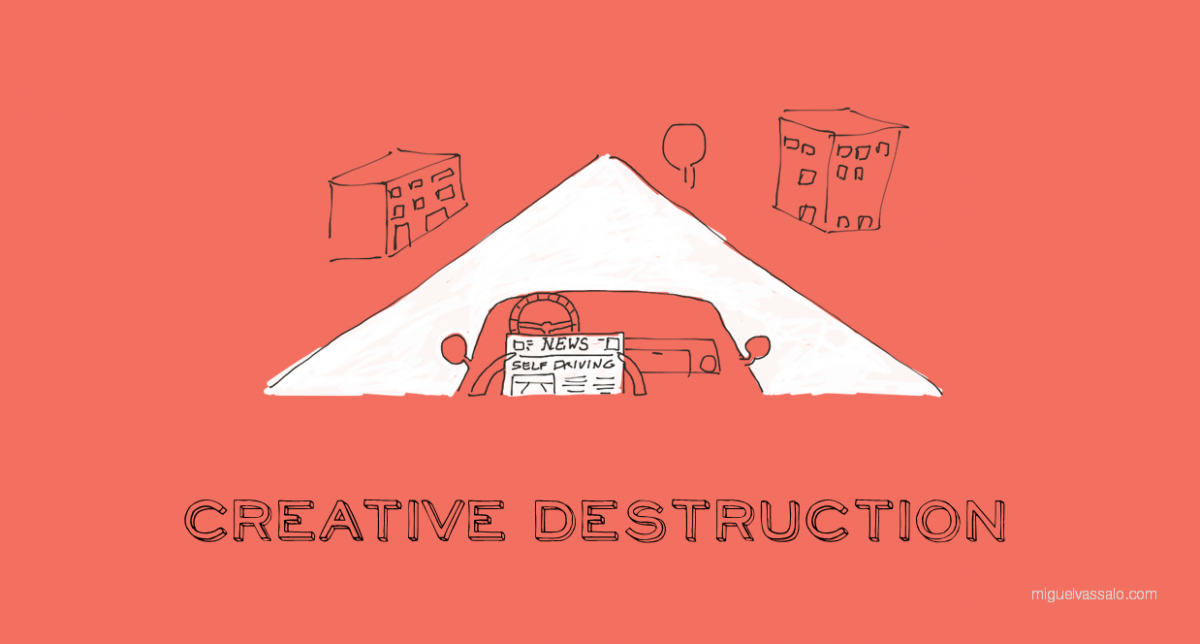
Proposed by the Austrian Schumpeter, the term “creative destruction” dates from 1942 but seems to gain a whole new meaning today. According to the economist, a product, a technology or a process replaces a previous one, making it obsolete. Therefore, for an innovation to occur, something has to cease to exist.
Those who attended the Web Summit had the opportunity to conclude once again that, in a few years, the automotive industry will be quite different from that which we know today. Most current business models that revolve around the motor vehicle will undergo profound changes or simply cease to exist.
This technological event brought together in Portugal a group of prominent figures from the automotive sector, representatives of all parties involved in this ongoing radical transformation. Some of the world’s leading manufacturers, regulators, entrepreneurs, investors and academics debated and outlined the industry’s short-term future.
The three fundamental pillars of the ongoing revolution are electro-mobility, connectivity and autonomous driving. The chairman of the Renault-Nissan alliance, Carlos Ghosn, started the first talk on the subject and ended up establishing these three points as strategic for the future development of the brands he represents. And during the three days of the conference, each of them was analyzed and dissected from various perspectives. Perhaps unsurprisingly, we all had the opportunity to note the unanimity reached regarding the pertinence of the themes. The most controversial point was only related to the time required for the widespread adoption of fully autonomous driving. Even so, given the complexity of the undertaking, the most pessimistic predictions believe it to be possible within 30 years.
“The three fundamental pillars of the ongoing revolution are electro-mobility, connectivity and autonomous driving.”
It, therefore, seems certain that all these profound changes are inevitable. First and foremost, they aim to resolve increasingly serious problems for humanity (global warming, traffic congestion in the world’s major urban centres and road accidents) and put into practice a vision of a world based on improving the quality of life of its inhabitants.
But it was also agreed that these transformations will not be painless, especially in the world of work. The example of truck drivers (representing, in the United States, a significant proportion of the population) and the potential unemployment generated by the emergence of truck platooning equipped with fully autonomous driving systems, were mentioned during the various interventions. In another speech, Lucas di Grassi, a Formula E driver, pointed out with irony that being involved in the development of autonomous driving systems is actively helping to kill his profession as a driver.
Should we, professionals in the automotive sector or related areas, be concerned about such a transformative prospect? Of course, we should. However, nothing will stop the natural evolution of technology. We have to seriously think about the role we want to play in this new scenario, as companies and professionals.
Should we be pessimistic? I think not. Provided that the prospect of change encourages us to provide our organizations and ourselves with the necessary skills to take advantage of the new horizons that come into view.
At the end of the day, it has always been this “creative destruction” that has opened the door to previously inconceivable business opportunities and professions.
** Opinion article originally published in Fleet Magazine paper edition /December 2016 **
_________________________
Thanks for reading! Check back soon for another article: AUTO FINANCE IN THE NEW MOBILITY ECOSYSTEM
All opinions expressed are my own and not to be associated with my employer or any other organization I am associated with.