One hundred percent electric vehicles are gradually winning over customers and promise to replace, within a few years, the internal combustion engine, as we transition to more ecologically sustainable forms of transport.
However, when the automotive industry intensified its research in the 1990s to find alternatives to fossil fuels, hydrogen was also deemed a viable option. And to this day, both lines of research have been pursued simultaneously. In reality, both technologies are based on propulsion by means of electric motors, but while the 100% electric is powered by lithium-ion batteries, the other uses fuel cells to convert hydrogen into electricity.
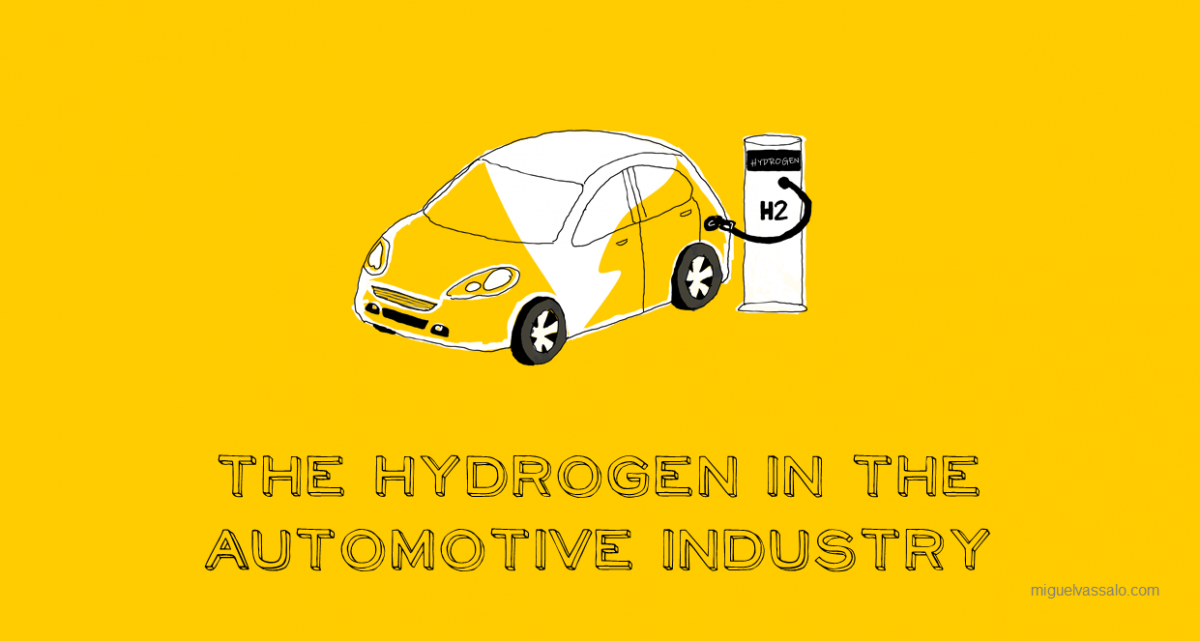
In addition to being the most abundant element in the universe, the potential of hydrogen as a clean fuel source is unquestionable. In fact, it is already commercially available in several countries, such as Japan, the United States and Europe, although with a very low level of adoption due to the currently limited refueling infrastructure and high acquisition cost.
In 1994, Daimler presented one of the first commercial vehicle prototypes using the fuel cell: THE NECAR 1. But it took 20 years for the Toyota Mirai to make history by being the first mass-produced passenger vehicle to use this technology. And since then, other manufacturers have followed in exploring its potential, such as Honda, Hyundai and the Chinese carmaker’s SAIC and Grove.
Hydrogen has two major advantages over fossil fuels for mobility applications. The energy released through oxidation produces only water. And it is infinitely renewable, at least as long as the sun is shining. But there are others. Without wanting to be exhaustive, we may mention just a few: The typical passenger car equipped with a fuel cell has refueling times and levels of autonomy comparable to those of internal combustion engines. It is also more energy-efficient than the internal combustion engine, although today in this regard it still lags behind 100% electric vehicles. Despite this, compared to 100% electric, this technology allows energy to be stored, for the same autonomy, in lighter and less bulky elements.
Let’s not forget that an underlying motivation for promoting hydrogen and fuel cell production lies in the search for independence from oil, namely in Japan, and not only due to issues of environmental sustainability.
However, major technical and infrastructural challenges arise. The production of hydrogen can be derived from several primary sources of energy (Coal, Natural Gas, Biomass, Solar, etc.), but it is a complex and expensive industrial process. Downstream, the construction of a complete, capillary distribution infrastructure for the supply of hydrogen represents a colossal investment and a huge logistical challenge, which, depending on an economic perspective based on demand, easily comes up against the chicken and egg paradox. Additionally, the high cost of manufacturing a hydrogen vehicle is mainly related to the cost of the materials used in the production of the fuel cell, namely the catalysts and other noble metals used, such as platinum.
At present, 100% electric are at an advantage thanks to their higher energy efficiency and because, to a certain degree, they are able to take advantage of the existing infrastructure. A competitive advantage from the cost standpoint that has made this the technology of choice for accelerated mass production, thus ensuring that the increasing restrictions on CO2 emissions can be met more quickly and easily. It is therefore likely that, in the coming years, hydrogen will remain a niche technology in passenger vehicles, albeit much more promising in the short term for commercial vehicles and sea and air transport.
It will be interesting to follow the duel as scientific advances take place in both technologies. Continue to study comparatively the cycle of energy needs, environmental impact and costs, from energy production to recycling, and involving the fuel distribution chain and automotive production, which today lean towards the 100% electric. And finally, let us also not forget that an underlying motivation for promoting hydrogen and fuel cell production lies in the search for independence from oil, namely in Japan, and not only due to issues of environmental sustainability. Therefore, access to raw materials and industrial policy in the countries will decisively influence the technological agenda of the future.
Reference:
Capgemini (2020). Battery electric vehicles in the fast track. Available at: https://www.capgemini.com/resources/battery-electric-vehicles-in-the-fast-track/ [Accessed Nov. 2020]
Hydrogen Council (2020). Path to hydrogen competitiveness: A cost perspective. Available at: https://hydrogencouncil.com/en/path-to-hydrogen-competitiveness-a-cost-perspective/ [Accessed Nov. 2020]
A group of companies, government organisations and an NGO (2010). A portfolio of power-trains for Europe: a fact-based analysis. The Role of Battery Electric Vehicles, Plug-in Hybrids and Fuel Cell Electric Vehicles. Available at: https://www.fch.europa.eu/sites/default/files/documents/Power_trains_for_Europe.pdf [Accessed Nov. 2020]
** Opinion article originally published in Fleet Magazine paper edition /November 2020 **
_________________________
Thanks for reading! Check back soon for another article.
All opinions expressed are my own and not to be associated with my employer or any other organization I am associated with.