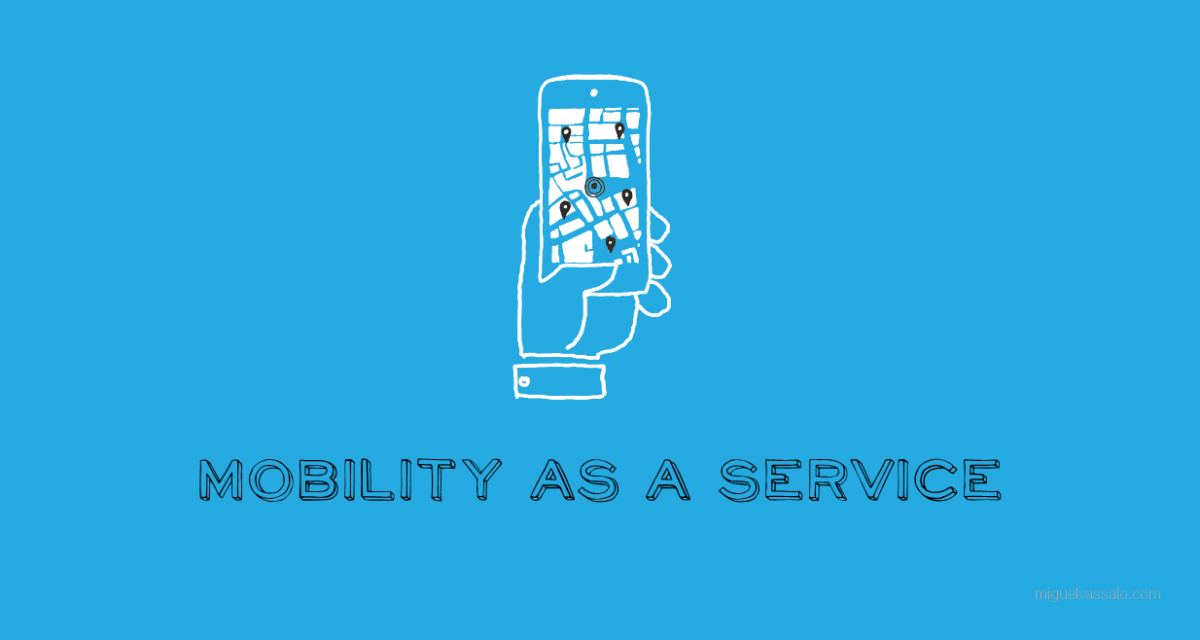
The key to building more prosperous and sustainable urban areas lies in the concept of smart cities. Naturally, one of its components is smart mobility, and in this regard, Mobility-as-a-Service (MaaS) represents a solution for solving current challenges in city mobility in a smart manner. Hyper-urbanisation, climate change and demographic and societal changes are some of the megatrends that put pressure on current transport infrastructure and represent clear obstacles to efficient mobility for people and goods.
Recent developments in the field of information and communication technologies (ICT), coupled with mobile broadband and the ubiquitous use of smartphones with apps and services based on geolocation, have opened doors for new business models and raised consumer expectations to new levels. Mobility-as-a-service aims to take advantage of the growing digitalisation and availability of data to respond to current challenges in the physical world. The proposal is to create a bridge between public transport and private mobility operators and encourage healthy integration, rather than the current fragmented model, which consists of data silos that fail to communicate with each other and consumers who are left to take pot luck.
Sampo Hietanen, current CEO of MaaS Global, a pioneer in the provision of this kind of service, defined mobility-as-a-service in a seminal 2014 article as, “a mobility distribution model in which a customer’s major transportation needs are met over one interface and are offered by a service provider”, whereby “Typically, services are bundled into a package – similar to mobile phone price-plan packages”.
“Mobility-as-a-service is designed to offer a more economical and sustainable alternative to the current default model of private cars, offering the equivalent convenience and bringing the famous subscription model to the transport market”
Let’s take a closer look at a more recent definition by the MAAS Alliance. Mobility-as-a-Service aims to integrate various forms of transport services into a single mobility service available on demand. In other words, the MaaS operator offers a range of different transport options, including public transport, taxis, ride-hailing, car, motorcycle, bicycle and scooter sharing, vehicle rental and leasing or a combination of several of these. In practice, consumers can plan their journey, book, pay for and receive their tickets and access information in real time by means of a single app. The app also assists in the selection of the best means of transport or intermodal or multimodal combination based on criteria such as travel time, price and impact on health and the environment, making real-time adjustments according to the weather and traffic conditions. In short, mobility-as-a-service is designed to offer a more economical and sustainable alternative to the current default model of private cars, offering the equivalent convenience and bringing the famous subscription model to the transport market.
Travel and transport costs represent a significant slice of families’ monthly budgets. It is estimated that the industry could be worth trillions, as a result of which companies from the widest variety of sectors have started to enter the market, offering services with differing degrees of integration. Pioneers such as MaaS Global in Finland and UbiGo in Sweden took the first steps a few years ago. Some of the traditional public transport operators, which form the backbone of mobility-as-a-service, intend to take on a central role as integrators. Large automakers have made massive investments in an effort to remain relevant in a changing environment, not to mention major technology companies and others with direct relationships with and access to a large number of consumers. Even though at the moment all are eminently local projects, major efforts are being made to transform mobility-as-a-service into a global solution.
Despite all the challenges involved in such a grand undertaking, mobility-as-a-service is going to significantly change the way in which we travel in the urban environment. A whole new ecosystem will emerge, where multiple organisations will cooperate in a network, breaking down traditional boundaries and optimising supply and demand. The role of the public sector has evolved from being a simple provider and manager of infrastructure to acting as a regulator and promoter of mobility services, looking to improve the quality of life of the whole of society. The consumer will not only be at the centre of the transport ecosystem but will also be its co-creator.
Reference:
Hietanen, S. (2014). “Mobility as a Service” – The new transport model? Eurotransport, 12(2), 2-4
MaaS Alliance. What is MaaS? Available at: https://maas-alliance.eu/homepage/what-is-maas/ [Accessed Mar. 2019]
** Opinion article originally published in Fleet Magazine paper and online edition /March 2019 **
_________________________
Thanks for reading! Check back soon for another article: THE FUTURE OF 5G CONNECTIVITY
All opinions expressed are my own and not to be associated with my employer or any other organization I am associated with.