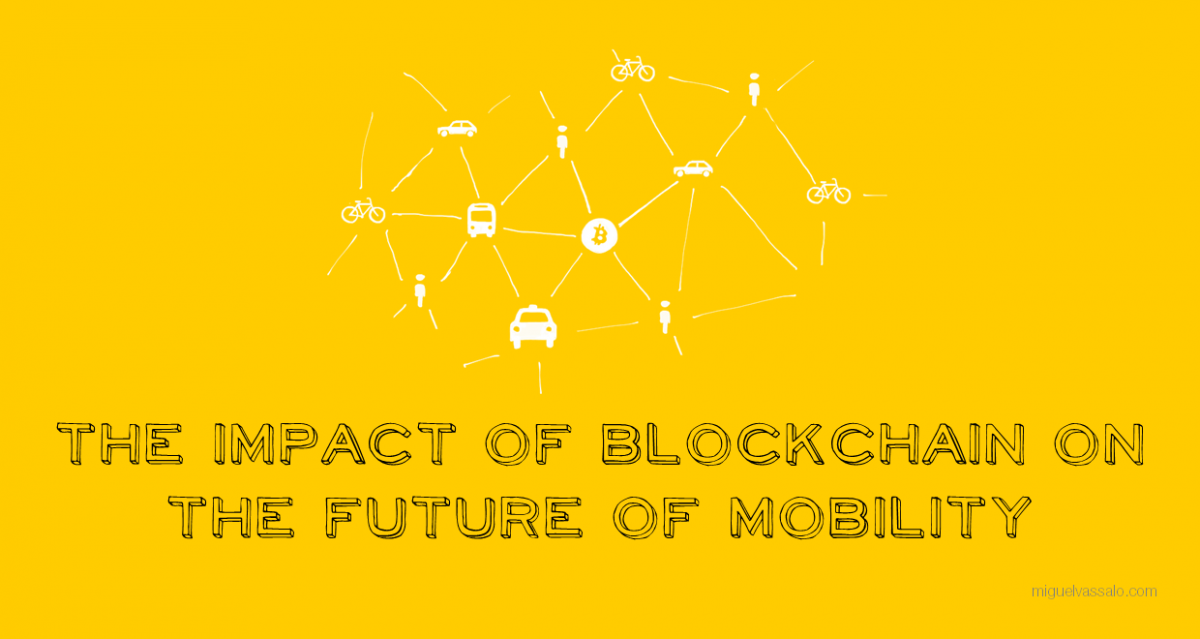
Considered the biggest revolution since the Internet and often associated with bitcoin and other cryptocurrencies, blockchain has the potential to transform various industries, from financial to health, passing of course by the automobile industry, and more generically shaping the future of mobility. Indeed, the first practical use of blockchain was to register and save bitcoin transactions, but not only are they not the same as the possibilities from using blockchain are actually quite broad.
In the end, blockchain is a gigantic, shared and incorruptible database that facilitates the process of recording transactions and tracking assets. Virtually anything of value can be followed and negotiated in the blockchain, reducing risks and costs for all stakeholders. This database is not stored in any specific location but rather distributed by a computer network scattered around the world, taking the form of a chronological blockchain of information connected to each other securely through encryption. Blockchain promises to create transparency and trust among users, reduce the risk of fraud, and reduce or eliminate transaction costs.
Firstly, this technology offers tremendous potential for the automobile industry. Logistics, maintenance and specific solutions such as fraud-proof odometers are just a few examples of application areas. It is therefore not surprising that several manufacturers are starting to join forces to accelerate the adoption of blockchain and to individually patent and test solutions supported by it. Let’s look at some examples.
“Blockchain promises to create transparency and trust among users, reduce the risk of fraud, and reduce or eliminate transaction costs.”
Porsche announces that it has been the first to successfully implement and test blockchain in a car. In this case, its seemingly prosaic application included locking and unlocking a vehicle in record time through an application and authorisation of temporary access to third parties. In another more disruptive aspect, it studies new business models based on the registration of encrypted data, focusing on autonomous driving.
In turn, through its Research Institute, Toyota is exploring blockchain opportunities in partnership with the MIT Media Lab in the development of a new mobility ecosystem. This initiative aims to promote a digital environment where users (companies and individuals) can securely share data, manage transactions on shared cars and save data on the use of vehicles that can, for example, be used to calculate insurance premiums.
Renault is joining Microsoft to create the first prototype of a digital car maintenance book. By boosting blockchain technology, customers will be able to save all their vehicle information in a simplified, secure and inviolable way.
When we approach the topic from a broader perspective, where the car is only part of a larger reality, blockchain is especially apt. Just look. Mobility as a Service (MaaS) only truly fulfils its promise when it is able to expeditiously identify the provision of available transport services at any given moment and to combine them efficiently by solving mobility problems in an urban environment. Blockchain can promote the decentralisation needed to activate this reality in contrast with the current extremely fragmented ecosystem where the parties have entrenched themselves in data silos. The eminently global and decentralised nature of the blockchain, based on a programmable and secure database, designed by default to protect privacy, presents the possibility of joining together the various services that are now dispersed and even incorporating others such as infrastructures (read for example tolls, parking and charging points for electric vehicles).
Imagine a blockchain-driven mobility ecosystem where multiple modes of transport are available, where we can easily plan our trip and book, use and pay at a single touch.
Although some challenges from the technical, social and regulatory point of view have to be overcome, blockchain is a strong candidate to become the operating system where the future of mobility runs.
Reference:
Tapscott, D., & Tapscott, A. (2016). Blockchain revolution: how the technology behind bitcoin is changing money, business, and the world. Portfolio/Penguin
Porsche AG (2018). Porsche introduces blockchain to cars [Press release]. 22 February. Available at: https://newsroom.porsche.com/en/porsche-digital/porsche-blockchain-panamera-xain-technology-app-bitcoin-ethereum-data-smart-contracts-porsche-innovation-contest-14906.html [Accessed Sep. 2018]
Toyota Research Institute (2017). TRI Explores Blockchain Technology for Development of New Mobility Ecosystem [Press release]. 22 May. Available at: http://www.tri.global/news/toyota-research-institute-explores-blockchain-technology-for-development-of-new-mobility-ecosystem-2017-5-22 [Accessed Sep. 2018]
Groupe Renault (2017). Groupe Renault teams with Microsoft and VISEO to create the first-ever digital car maintenance book prototype [Press release]. 25 July. Available at: https://media.group.renault.com/global/en-gb/groupe-renault/media/pressreleases/94238/groupe-renault-microsoft-et-viseo-sassocient-pour-creer-le-premier-prototype-de-carnet-dentretien-nu1 [Accessed Sep. 2018]
** Opinion article originally published in Fleet Magazine paper and online edition /September 2018 **
_________________________
Thanks for reading! Check back soon for another article: ARTIFICIAL INTELLIGENCE AND THE FUTURE OF LOGISTICS AND MOBILITY
All opinions expressed are my own and not to be associated with my employer or any other organization I am associated with.